(RE-)DESIGN and DEVELOPMENT JOURNEY
—Are you curious for more? Would you like to get in touch? Feel free to contact our lead directly for any questions or inquiries you may have. Tikvah Breimer (MSc MAEd MSc) Director tikvah@studioblended.com +31 6 42 47 29 69
This phase is about the design and development of a learning journey for a course, a stage that follows up on our Design Studio. It is particularly relevant for highly curated online courses or degrees, in technology enabled education, such as a MOOC.
Elements of this (re)design journey are equally valid for the (re)design of other university courses, such as blended courses, and equally for capacity development trainings.
—
OUTPUT
A high quality, end product: a succesful (online) course/training/degree.
—
Since our independent senior advisor was trained at the Technical University Delft (TU/D) - we also largely follow their outstanding and contemporary design and development approaches for online courses.
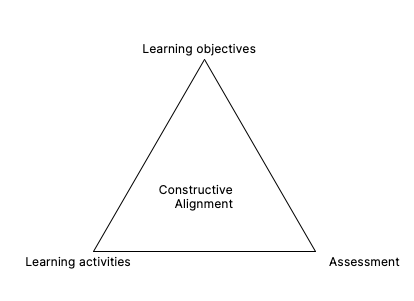
Constructive alignment is essential throughout the roll-out of this phase. It means, starting with the learning objectives, and then going straight to the way we want to evaluate, or make that learning visible (i.e. not jumping to the activities we’d like to include). Once designed, backward design (Wiggins & McTighe 2011) can help us further to realise whether constructive alignment was achieved.
![]() Our technical approach to curriculum design is based on ‘constructive alignment’. You achieve it with backward design, which has proved to be a robust technique for design. Source image: Biggs, J., & Tang, C. (2011). Teaching for Quality Learning at University. Maidenhead, UK: Open University Press.
Our technical approach to curriculum design is based on ‘constructive alignment’. You achieve it with backward design, which has proved to be a robust technique for design. Source image: Biggs, J., & Tang, C. (2011). Teaching for Quality Learning at University. Maidenhead, UK: Open University Press.
—
We like to work with concrete outputs, as they allow all of us to visualise what we mean, and to be dedicated to conclusions through the positive effect of multiple internal deadlines.
We work very structurally and pragmatically - equally as with a strong positive, idealistic and bespoke approach to your content.
The development and initial design, are iterative, as the act of developing also further informs the design.
Every output for the various phases, requires a sign off by the decision-maker on the content.
The Carpe Diem approach brings all relevant stakeholders together in an intensive, structured workshop. But, since in our approach we already did a collaborative Design Studio, we can now allow more space and oxygen, and in a more organic way design and develop draft outputs remotely, with face to face dialogue moments with decision-makers at crucial times. All whilst keeping a close eye on your timeline.
—
PHASES IN THE PROJECT
Phase A. Design.
- Blueprint - this lays out the essential and aspirational aspects of the course, by design.
It includes elements from mission&vision, target group, learning objectives, assessment, look & feel and more.
- Curriculum (a further development following the Design Studio output, see also Technical resilience)
- Bespoke Pedagogy
- Modules, by design
Phase B. Development.
- Storyboard. A storyboard visually represents the process that we will be later building into the learning management system.
This Storyboard shows the narrative structure proposed for the online course, the result of co-creation and partnering with the team to date. It is an accumulation of all the design work done so far.
It’s where all the envisioned content, texts, media, notes are bundled in one place. It serves as a guide for the ensuing development of the online course.
It reads like a script, containing all the following in one place, and fully developed now:
- Translation of the pedagogy as a concrete leading thread throughout
- Assessment (often times automated)
- Planning
- On screen texts per element
- Media (i.e. video, podcast)
- Studyload estimation
- Evidence based angle
- Engagement
- Peer interaction (can also be with a virtual peer, AI)
- Flexibility
- Activities
- (bespoke aspects)
Phase C. Video production
Generally, video production is the highest cost associated with online courses. That’s why, depending on the budget that you have, we have to find the best workflow to produce educational videos.
Generally we’re looking at videos of 2-12 min, meaning they are highly curated.
We work with talented and qualified filmmakers from our freelancer pool, and together with them take you through the entire required workflow:
- Pre-production - the lionshare of the time. Involves truly curating the videos within the overal logic of the Storyboard, establishing their ‘style’ and the background we want. It also involves preparation of the team such as with storyboards/scripts, any supporting slides or animations they need, a rehearsle, and any copyright agreements you need.
- Production - intensive time-efficient days of creating the actual raw material in the Studio or outdoors/on-location together with the filmmaker. Our independent senior advisor is present as content director.
- Post-production - this is done by the filmmaker and involves the editing.
Alternatively, you may want animations.
Phase D. Creating/building.
After this design stage, you’ll be ready to actually quite easily build the course design into technology. We can also coordinate a group of student assistants for you, to do this step.
Importantly, we work with lead users, from within your institute with whom we can test run the online course and its modules, and improve where needed.
—
Duration: at least 2 seasons.
For whom: (re)designing a learning journey is a collaborative effort with a course content team - such as professors, lecturing/research staff - and your own project management staff and - if applicable - project officers for the European grant.
Price: usually part of a package price with the Design Studio included. In the case of a MOOC, this price is already included in the budget.
Location: we work hybrid with you as a client, on location and remotely, as the work demands.
—
We take on the double role as project manager and independent senior advisor for the content, pedagogy and curriculum design and development.
Our senior advisors expect to have an equal partner relationship with the client’s main focal point (i.e. a coordinator and the head of research in charge of signing off content), whereby client and advisor work together, combining the advisor’s specialist knowledge with relevant knowledge about the content, the organisation and access to the relevant departments.
Shared responsibility and joint decision making for the sake of ownership, allow the success and relevance of the identified outcomes and outputs.
—
—
PRICE
Our Studio gives you the desired result and impact, with a
package price for your bespoke assignment. Let’s have a call to hear more about what you want and need.
—
CONTACT
Feel free to email or call our director directly.
Tikvah Breimer (MSc MAEd MSc) tikvah@studioblended.com
+31 6 42 47 29 69
—
MASSIVE OPEN ONLINE COURSE (MOOC) funded by the ERC
—
2025 - 2026 (1 year)
—
STUDIOBLENDED is currently working on the realisation of an impactful MOOC for an institute for capacity development within a European University (March 2025 - March 2026). The challenge of this client is transforming the scope of the 4 year research program, into a scope for a playful, light yet superintersting learning journey (9 studyhours) and develop it into a succesful MOOC.
We started with a Design Studio, and followed through with a design journey.
European funded program.
More information follows soon.
![]()
![]()
—
Wiggins, J. & Mc Tighe, G. 2011 Understanding by design framework, Whitepaper Available: https://files.ascd.org/staticfiles/ascd/pdf/siteASCD/publications/UbD_WhitePaper0312.pdf [Accessed: December 4, 2025].
Human resilience
Modular
Time dimension
Evidence-based design
Financial health and resilience by (re)design
Innovative and deep pedagogy
Multi- Inter- and transdisciplinary
Blended
Bichronous
Designed to be green (and technological simplicity) Nature and aspirations
Flexibilisation and personalisation
Simplicity and decluttering
Elements of this (re)design journey are equally valid for the (re)design of other university courses, such as blended courses, and equally for capacity development trainings.
—
OUTPUT
A high quality, end product: a succesful (online) course/training/degree.—
TRANSFORMATION
We follow the Carpe Diem method for course design/development. The Carpe Diem process is a collaborative, team-based, online learning design process, created through research and prototyping from the year 2000, and embedded in well-respected pedagogical research (Salmon & Wright 2014, p.54).Since our independent senior advisor was trained at the Technical University Delft (TU/D) - we also largely follow their outstanding and contemporary design and development approaches for online courses.
Constructive alignment is essential throughout the roll-out of this phase. It means, starting with the learning objectives, and then going straight to the way we want to evaluate, or make that learning visible (i.e. not jumping to the activities we’d like to include). Once designed, backward design (Wiggins & McTighe 2011) can help us further to realise whether constructive alignment was achieved.
 Our technical approach to curriculum design is based on ‘constructive alignment’. You achieve it with backward design, which has proved to be a robust technique for design. Source image: Biggs, J., & Tang, C. (2011). Teaching for Quality Learning at University. Maidenhead, UK: Open University Press.
—
PROGRAM WITH YOU AS COORDINATOR
The (re)design and development journey is a quite extensive phase, because it involves, dialogue, discussions, provocations, deep listening and more with quite a few stakeholders. Below we give the contours of it.We like to work with concrete outputs, as they allow all of us to visualise what we mean, and to be dedicated to conclusions through the positive effect of multiple internal deadlines.
We work very structurally and pragmatically - equally as with a strong positive, idealistic and bespoke approach to your content.
The development and initial design, are iterative, as the act of developing also further informs the design.
Every output for the various phases, requires a sign off by the decision-maker on the content.
The Carpe Diem approach brings all relevant stakeholders together in an intensive, structured workshop. But, since in our approach we already did a collaborative Design Studio, we can now allow more space and oxygen, and in a more organic way design and develop draft outputs remotely, with face to face dialogue moments with decision-makers at crucial times. All whilst keeping a close eye on your timeline.
—
PHASES IN THE PROJECT
Phase A. Design.- Blueprint - this lays out the essential and aspirational aspects of the course, by design.
It includes elements from mission&vision, target group, learning objectives, assessment, look & feel and more.
- Curriculum (a further development following the Design Studio output, see also Technical resilience)
- Bespoke Pedagogy
- Modules, by design
Phase B. Development.
- Storyboard. A storyboard visually represents the process that we will be later building into the learning management system.
This Storyboard shows the narrative structure proposed for the online course, the result of co-creation and partnering with the team to date. It is an accumulation of all the design work done so far.
It’s where all the envisioned content, texts, media, notes are bundled in one place. It serves as a guide for the ensuing development of the online course.
It reads like a script, containing all the following in one place, and fully developed now:
- Translation of the pedagogy as a concrete leading thread throughout
- Assessment (often times automated)
- Planning
- On screen texts per element
- Media (i.e. video, podcast)
- Studyload estimation
- Evidence based angle
- Engagement
- Peer interaction (can also be with a virtual peer, AI)
- Flexibility
- Activities
- (bespoke aspects)
Phase C. Video production
Generally, video production is the highest cost associated with online courses. That’s why, depending on the budget that you have, we have to find the best workflow to produce educational videos.
Generally we’re looking at videos of 2-12 min, meaning they are highly curated.
We work with talented and qualified filmmakers from our freelancer pool, and together with them take you through the entire required workflow:
- Pre-production - the lionshare of the time. Involves truly curating the videos within the overal logic of the Storyboard, establishing their ‘style’ and the background we want. It also involves preparation of the team such as with storyboards/scripts, any supporting slides or animations they need, a rehearsle, and any copyright agreements you need.
- Production - intensive time-efficient days of creating the actual raw material in the Studio or outdoors/on-location together with the filmmaker. Our independent senior advisor is present as content director.
- Post-production - this is done by the filmmaker and involves the editing.
Alternatively, you may want animations.
Phase D. Creating/building.
After this design stage, you’ll be ready to actually quite easily build the course design into technology. We can also coordinate a group of student assistants for you, to do this step.
Importantly, we work with lead users, from within your institute with whom we can test run the online course and its modules, and improve where needed.
—
FACTS AND FIGURES
Startingdate: following a Design StudioDuration: at least 2 seasons.
For whom: (re)designing a learning journey is a collaborative effort with a course content team - such as professors, lecturing/research staff - and your own project management staff and - if applicable - project officers for the European grant.
Price: usually part of a package price with the Design Studio included. In the case of a MOOC, this price is already included in the budget.
Location: we work hybrid with you as a client, on location and remotely, as the work demands.
—
PARTNERING
We come alongside a client, and operate as equal partners throughout the project duration of an advisory assignment.We take on the double role as project manager and independent senior advisor for the content, pedagogy and curriculum design and development.
Our senior advisors expect to have an equal partner relationship with the client’s main focal point (i.e. a coordinator and the head of research in charge of signing off content), whereby client and advisor work together, combining the advisor’s specialist knowledge with relevant knowledge about the content, the organisation and access to the relevant departments.
Shared responsibility and joint decision making for the sake of ownership, allow the success and relevance of the identified outcomes and outputs.
—
MEET THE INDEPENDENT SENIOR ADVISOR
Tikvah Breimer (MSc MAEd MSc) is an independent senior advisor, teacher trainer, and director of STUDIOBLENDED.—
PRICE
Our Studio gives you the desired result and impact, with a
package price for your bespoke assignment. Let’s have a call to hear more about what you want and need.—
CONTACT
Feel free to email or call our director directly.Tikvah Breimer (MSc MAEd MSc) tikvah@studioblended.com
+31 6 42 47 29 69
—
KEY PROJECTS
MASSIVE OPEN ONLINE COURSE (MOOC) funded by the ERC
—
2025 - 2026 (1 year)
—
STUDIOBLENDED is currently working on the realisation of an impactful MOOC for an institute for capacity development within a European University (March 2025 - March 2026). The challenge of this client is transforming the scope of the 4 year research program, into a scope for a playful, light yet superintersting learning journey (9 studyhours) and develop it into a succesful MOOC.
We started with a Design Studio, and followed through with a design journey.
European funded program.
More information follows soon.

—
REFERENCES
Salmon, G. & Wright, P. (2014) Transforming Future Teaching through ‘Carpe Diem’ Learning Design, Educ. Sci. 2014, 4, 52-63; doi:10.3390/educsci4010052.Wiggins, J. & Mc Tighe, G. 2011 Understanding by design framework, Whitepaper Available: https://files.ascd.org/staticfiles/ascd/pdf/siteASCD/publications/UbD_WhitePaper0312.pdf [Accessed: December 4, 2025].
OUR FINITE SET OF DESIGN ANGLES
Technical resilienceHuman resilience
Modular
Time dimension
Evidence-based design
Financial health and resilience by (re)design
Innovative and deep pedagogy
Multi- Inter- and transdisciplinary
Blended
Bichronous
Designed to be green (and technological simplicity) Nature and aspirations
Flexibilisation and personalisation
Simplicity and decluttering
Resilient education that
stands the test of time - by design.
Prefer to have direct contact?
Feel free to contact us:
Tikvah Breimer (MSc MAEd MSc)
Independent senior advisor, teacher trainer, director.
tikvah@studioblended.com
+31 6 42 47 29 69
STUDIOBLENDED Non Profit Foundation
Registration Chamber of Commerce
KvK-number 86242598 (Dutch)
VAT identification number
NL 86 39 07 29 5 B01
Bankaccount
NL40 INGB 0709 6156 04
SWIFT/BIC: INGBNL2A
StudioBlended Foundation
Feel free to contact us:
Tikvah Breimer (MSc MAEd MSc)
Independent senior advisor, teacher trainer, director.
tikvah@studioblended.com
+31 6 42 47 29 69
STUDIOBLENDED Non Profit Foundation
Registration Chamber of Commerce
KvK-number 86242598 (Dutch)
VAT identification number
NL 86 39 07 29 5 B01
Bankaccount
NL40 INGB 0709 6156 04
SWIFT/BIC: INGBNL2A
StudioBlended Foundation