WORKSHOP ON THE USE OF AI
—“Thank you so much. It was a real revelation.” Tannya Pico (PhD), participant in a (crash) course on the use of AI for desktop research
‘I want AI to do my laundry and dishes, so that I can do art and writing, not for AI to do my art and writing so that I can do the laundry and dishes.’
Joanna Maciejewska, poet
Curious?
If you’d like to know more, reach out to Tikvah on tikvah@studioblended.com or +31 6 42 47 29 69
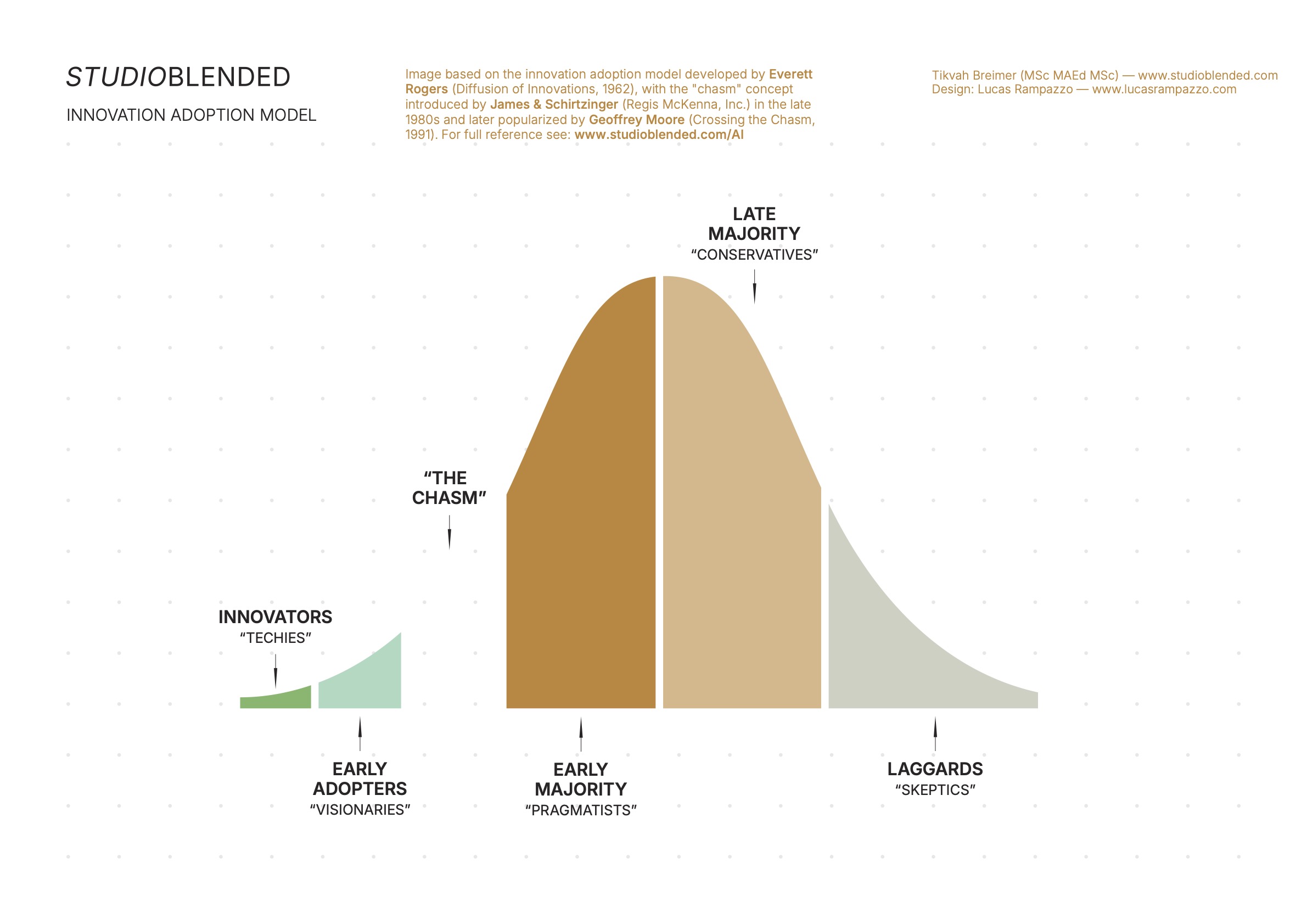
Image: Innovation adoption model. Based on the model developed by Everett Rogers (Diffusion of Innovations, 1962), with the "chasm" concept introduced by James & Schirtzinger (Regis McKenna, Inc.) in the late 1980s and later popularized by Geoffrey Moore (Crossing the Chasm, 1991).
Are you an academic researcher and new to Artificial Intelligence (AI)? Perhaps you consider yourself a ‘laggard’, and you feel like you are too slow or skeptical and are falling behind. Or perhaps, you are simply such a novice, that you have no idea even where to begin.
Or alternatively, perhaps you are a head of department, and see how your research team is struggling with FUDD: Fear, Uncertainty, Doubt and Disinformation - around the use of AI.
We offer a workshop on the use of ‘AI’ particularly for academic researchers who feel like ‘dummies’ when it comes to AI - with a variety of activities for those who have already tested the water, and possibly consider themselves rebels.
The workshop focuses on academic literature review and writing, but is very relevant also for your teaching practice.
This is not a side-step from Education.
AI has become inescapable, whether you use it or not. And it can free up time for you.
This workshop is unique as it offers a guided, step-by-step introduction for novices (and advanced) academic users of AI.
How is this AI workshop different from what you can already find on the market? This workshop is unique in that it adopts a thorough pedagogy and step-by-step approach for novices.
The workshop was created adhering to the logic of what the subject matter demands, from the bottom up. Much like working with clay. As opposed to superimposing some instructional structure on it or a preconceived format. Through test running and piloting the set up, through exchanges with experts in AI in the field, a robust and attractive set up was created, that follows pedagogy and a task-based approach specifically targeting novices.
Given that AI is such a rapidly changing field, encompassing a vast amount of technical knowledge, the risk of a workshop is to get bogged down in a lot of explanations about what AI is and how it works, while failing to show participants how to get started with AI.
Instead, therefore, this bespoke workshop, takes another approach. Through the doing, comes understanding. Following authentic questions from the group, and peer interactions, brief knowledge-intermezzo’s are held, with throughout the focus being i equipping participants to engage with AI. The result is that participants dare to simply try, experiment and work with AI. They can then take it from there and continue with their own unique exploration, now that they know how to find their way around in the world of AI.
—
FACTS AND FIGURES
Startingdate: we can determine the best moment with youDuration: one morning or afternoon (4 hours)
For whom: for your team of academic lecturers/researchers or any relevant constellation of academics who are fairly new to the use of AI.
Price: €1250 excl VAT lumpsum (with a maximum of 10 participants, half a day)
See below for a breakdown
Downpayment € 750 euro.
Language: English
Location: we agree on a suitable location together
—
TRANSFORMATION
Today, universities are under immense pressure, and so, by default, you as an academic researcher and lecturer are too. Nature (2025) writes: ‘Faculty members are facing ever bigger workloads and intense competition for funding as research budgets are squeezed. Tightening visa regulations are undermining global (...) researcher mobility, while academic freedom is coming under pressure from politicians who see universities as unrepresentative of all parts of the social and political spectrum.’AI has the potential to free up time for you when working on your literature reviews and publications.
The challenge we frequently see with academics, is simply, where to start. Especially when you feel resistance, or even have concerns regarding privacy issues. Perhaps the increasing amount of policy, at European level, and at university and faculty levels, are putting you off too.
Ethically speaking you cannot be forced to use AI or force others to use it (such as your students). It must always be a free choice. But equally, if you do not know fully about it, do you truly have agency over your choice to use it or not?
We approach entering the AI scene, in a playful manner. With us, you ultimately start to orientate yourself in the world of AI, without feeling like youare in the middle of an avalanche of information.
We bring back simplicity.
We also bring back craftmanship, rather than taking it away.
Writing is not only technical, it is equally an art. AI actually can amplify what makes us human. As Stabel (2025) writes: ‘There's a peculiar paradox here: AI [A technology] forces us to consider what is truly human in education. We must learn to trust ourselves more. And perhaps that will lead to a revaluation of craftsmanship and human expertise.’
In this workshop we do not take that craftmanship away from you, instead, quite on the contrary, we create more space and time for you, to actually enjoy your writing. The philosopher Richard Sennett (2009) writes about how the hand can think. His work is an exploration of craftsmanship - the desire to do a job well for its own sake - as a template for living.
We offer this AI workshop so that you can get started. Become smarter with your time, energy and cost investment, while you are also more aware of what to do and what not to do with your published and unpublished work.
—
PROGRAMME FOR THE PARTICIPANTS
Prior to the workshop, as a way to ‘kick-start the workshop, participants receive a handout how to create a ‘formal’ Google Account, and how to organise their own curated set of sources.The workshop facilitator actively approaches each participant to ensure they understand what is required, and in this way ensures maximum impact of the workshop relevant each participant’s own work.
A hands-on 4 hour exclusive and bespoke session for your curated group. Rather than opening with a talk, we start with action and then the group is taken through step-by step tasks. Through the peer exchanges, and group exchanges that are guided, coupled with mini-talks, knowledge, understanding and skill in AI is acquired.
There is a ‘differentiation space’ for those who are already more familiar with AI, as they are encouraged to explore ‘local AI’ and the EduGenAI pilot.
The workshop ends with all groups coming together to round up, share take aways and consider ways forward, whether you decide to use AI or not for academic writing.
—
PROGRAMME WITH YOU AS COORDINATOR
We follow the following set-upPrior to delivery, we have a exploritory call / in person meeting to co-create a bespoke workshop for your team, and define what success looks like.
Post workshop, we touch base with you, and reflect remotely with you as coordinator, to evaluate impacts and possible spin-offs. We usually do this 1 season (3 months) after the workshop for the most authentic and genuine evaluation and way forward.
—
MEET THE TRAINERS AND THEIR EXPERTISE
Tikvah Breimer (MSc MAEd MSc) is an independent senior advisor, teacher trainer, and director of STUDIOBLENDED.The graphic designer is part of the freelancer pool.
—
PRICE
The full package, is €1250,- excl VAT (21%), excl travel costs and excl material costs (printing posters). The package price includes the graphic designer.If a client wishes to record the workshop, or deliver it in a hybrid way, a different price is negotiated as it involves a different preparation and influences copyrights.
We expect our clients on location to provide for:
- A suitable venue on campus [alternatively we can suggest an attractive venue outside]
- Flipchards and flipchart paper (number depending on group size)
- Markers, notes that can be attached to paper
- A projector and a screen
- Refreshments and - where applicable - lunch
—
CONTACT
Feel free to email or call our director directly. Tikvah Breimer (MSc MAEd MSc) tikvah@studioblended.com+31 6 42 47 29 69
—
KEY PROJECTS
[follows 2026]—
REFERENCES
European University Association (EUA) 2025. ‘How universities can protect and promote academic freedom. EUA principles and guidelines’.Everett Rogers (1962) Diffusion of Innovations. Illinoia, U.S.: Free Press of Glencoe.
Landymore, F. (2025) ‘ChatGPT has already polluted the internet so badly that it’s hobbling future AI development’. Futurism, June 16. Available:
https://futurism.com/chatgpt-polluted-ruined-ai-development (Accessed: October 27, 2025).
Geoffrey Moore (1991) Crossing the Chasm. HarperCollins Publishers. London and New York.
James, L.R. and Schirtzinger, W. 1980s. Crossing the Chasm. Sunnyvale, California: Regis McKenna, Inc..
Liboreiro, Jorge (2025) ‘Choose Europe’, von der Leyen tells US scientists threatened by Trump policies’ Euro News, May 5. Available: https://www.euronews.com/my-europe/2025/05/05/choose-europe-von-der-leyen-tells-us-scientists-threatened-by-trumps-policies?utm_source=chatgpt.com (Accessed: October 27, 2025).
Nature (2025) ‘The future of universities’. September 24, 2025. Available: https://www.nature.com/articles/d41586-025-03065-w (Accessed: October 27, 2025).
Senett, R. (2009) The Craftsman. City of Westminster, London: Penguin Books.
Stabel, K. (2025) ‘Education in the Age of AI: A plea for Craftsmanship’. Blogpost by deputy director of Risbo, Erasmus University Rotterdam, The Netherlands. Available: https://www.linkedin.com/pulse/education-age-ai-plea-craftmanship-kris-stabel-qq7le/ (Accessed: October 27, 2025)
Liu, D. and Bridgeman, A. (2025). ‘What to do about assessments if we can’t out-design or out-run AI?’ University of Sydney. Available: https://educational-innovation.sydney.edu.au/teaching@sydney/what-to-do-about-assessments-if-we-cant-out-design-or-out-run-ai/ (Accessed: October 27, 2025).
Universiteiten van Nederland (2025). Statement on Academic freedom - the Rectors of the Dutch Universities Available: https://www.universiteitenvannederland.nl/en/current/news/statement-on-academic-freedom-the-rectors-of-the-dutch-universities-2025#:~:text=Freedom%20of%20thought%2C%20expression%2C%20and,integrity%2C%20quality%2C%20and%20professionalism. (Accessed: October 27, 2025).
Winter, de J. C. F., Dodou, D., & Stienen, A. H. A. (2023). ChatGPT in education: Empowering educators through methods for recognition and assessment.
World Resources Institute 2025, AI can help or harm the planet. It’s up to us. Blog entry.
OUR FINITE SET OF DESIGN ANGLES
Technical resilienceBig ideas
Paradigm shifts/decade strong
Human resilience
Modular
Time dimension
Evidence-based design
Financial health and resilience by (re)design
Innovative and deep pedagogy
Assesment / evaluation
Multi- Inter- and transdisciplinary
Flexibilisation and personalisation
Simplicity and decluttering
Artificial Intelligence
Resilient education that stands the test of time - by design.
Prefer to have direct contact?
Feel free to contact us:
Tikvah Breimer (MSc MAEd MSc)
Independent senior advisor, teacher trainer, director.
tikvah@studioblended.com
+31 6 42 47 29 69
STUDIOBLENDED Non Profit Foundation
Registration Chamber of Commerce
KvK-number 86242598 (Dutch)
VAT identification number
NL 86 39 07 29 5 B01
Bankaccount
NL40 INGB 0709 6156 04
SWIFT/BIC: INGBNL2A
StudioBlended Foundation
Feel free to contact us:
Tikvah Breimer (MSc MAEd MSc)
Independent senior advisor, teacher trainer, director.
tikvah@studioblended.com
+31 6 42 47 29 69
STUDIOBLENDED Non Profit Foundation
Registration Chamber of Commerce
KvK-number 86242598 (Dutch)
VAT identification number
NL 86 39 07 29 5 B01
Bankaccount
NL40 INGB 0709 6156 04
SWIFT/BIC: INGBNL2A
StudioBlended Foundation